Night of Fear
It is a distillation of the fears of women; to be alone, to be defenceless, to be trapped, to be pursued, captured, assaulted, murdered, confronted by a man unknown to them, a stranger who has chosen them, singled them out as prey, aggressive and uncommunicative, no way to negotiate, to bargain, an animal giving only an impression of humanity and expressing only hunger for violence.
Inconceivably proposed as the pilot of episode of an Australian television show to be named Fright, the production supported by the Australian Broadcasting Commission who provided crew and facilities, Night of Fear was promptly banned when assessed by the Australian Classification Board, a decision which was appealed resulting in a “restricted” rating, suitable for adults only.
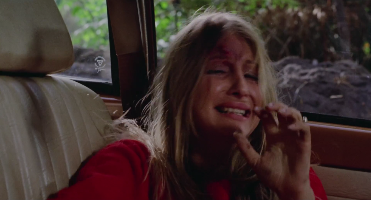
Written and directed by Terry Bourke, a maverick of the film industry who got the job done but did nothing to ingratiate or endear himself to those he collaborated with as cast and crew, Night of Fear is primal but effective, released in 1972, two years before The Texas Chain Saw Massacre and with a similar approach yet even more stripped back, the characters given no names or backstory with little dialogue beyond futile cries for help.
A grim experience more than a narrative, consciously disjointed, her car driven off the road and down a dirt track where it becomes fouled in a ditch, Carla Hoogeveen is “the Girl” and Norman Yemm is “the Man,” unkempt, unwashed, living in a dirty shack of caged animals and newspaper clippings of murders, walking with a caliper on his leg, the clank announcing his approach, something subhuman excised from the norms of society.
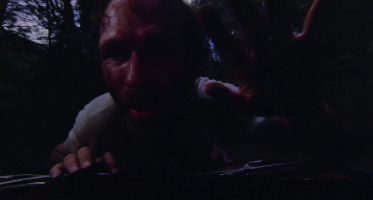
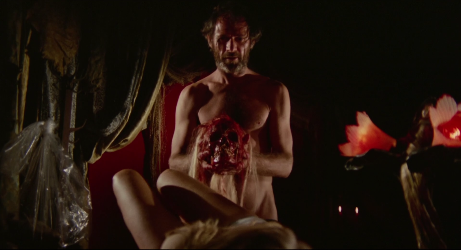
Yemm in fact an opera singer and champion athlete, providing him with the wiry physique of the hunter, Night of Fear is raw and primal, using archetypes of “the other” to project dread while the joyous blonde woman is “the victim,” attempting to flee but lost in the woods only a stone’s throw from the civilisation in which she thrived, moving from despair and exhaustion to collapse, held captive even in her nightmares of Satanic rituals.
Running to fifty remorseless minutes, belying its intended television distribution, Night of Fear cannot be regarded as high art but it is powerful, if also questionable, unshackled from any conventional dramatic constraints, an undiluted template for much which has followed in horror cinema and inventive in its bombardment of torture and misery, a bloody landmark of Australian film but one which begs the question of how it was ever considered for broadcast.
Night of Fear is streaming on Shudder now