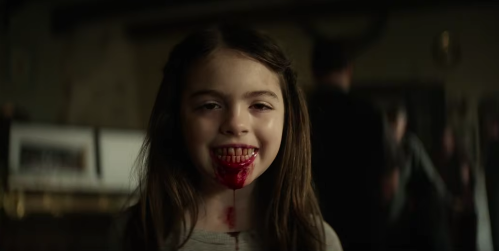
Lee Cronin’s The Mummy
An international correspondent working out of Cairo along with his family, Charlie Cannon has finally had the offer of the big time, an anchor position back home, but the breaking good news is swiftly superceded by another story, a tragedy, as he realises his daughter Katie is not playing in the courtyard where he left her, hidden candy wrappers and a hole in the fence indicating that she has been groomed and taken.
Eight years pass, and Charlie, Larissa and their children Sebastián and Maud, born shortly after Katie vanished, live in New Mexico with Larissa’s mother Carmen Santiago when the impossible call comes through: a plane crash near Aswan in the desert, an ancient basalt sarcophagus, within it Katie, still alive though neglected, deteriorated, unresponsive, the family hoping that being among her family in Albuquerque will aid her recuperation.
The third feature from director Lee Cronin following The Hole in the Ground and Evil Dead Rise, now apparently a banner name in the same way as John Carpenter, The Mummy would like everyone to know it is a horror movie, the opening scene the descent into the subterranean chambers of a black pyramid buried in the sand, explored by lamplight presumably because the occupant of the coffin demands tradition, the lid lifted and the thing within the wrappings twitchy and angry.
Investigation of the disappearance beginning in an interrogation room lit with a forty watt bulb, in New Mexico almost a decade later the Cannon family (Jack Reynor, Laia Costa and abuela Verónica Falcón) continue their aversion to modern conveniences, lamps dimmed and curtains drawn and Katie (Natalie Grace) dragged upstairs backwards in a wheelchair bumping against every wooden step rather than dad simply carrying her, as if deliberately offering further trauma might spring her from her catatonia.
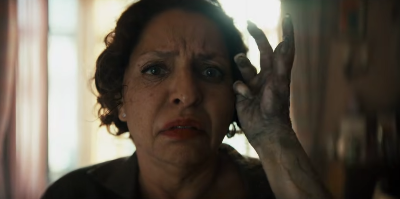
Katie’s needs dominating the family, conspicuously wealthy but determined to handle the difficult situation themselves without a visiting nurse or even a baby monitor, yet leaving her alone in her room and simply bandaging her foot after she stabs herself repeatedly rather than taking her to a hospital, no suggestion ever made that restraints might stop her harming herself and others, Maud’s behaviour changing from bratty to sinister is easy to ignore having grown accustomed to ignoring other warning signs in the household down the years.
Cronin favouring split diopters over adequate lighting, Detective Zaki (May Calamawy) diligently working from a cellar lit only by a cathode ray television set, The Mummy is a dingy slog which replays scenes from The Exorcist, Evil Dead and Poltergeist with no conspicuous original ideas to support increasingly desperate attempts to shock, licking embalming fluid off the parquet floor before attacking a priest with stolen dentures (Did he die? Were the police called? Who knows?), the thin wrapping of bandages inscribed with ancient texts insufficient to hold interest in a tedious demonic possession for anything near two and a quarter hours.
Lee Cronin’s The Mummy is currently on general release