Point Blank
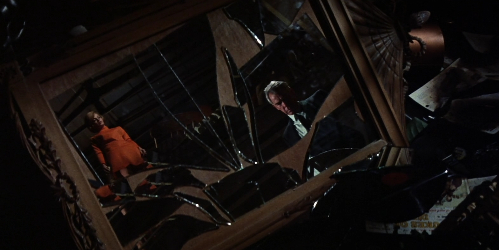
He is a ghost in the shadows, double-crossed and left for dead by his supposed friend Mal Reese in a cell in Alcatraz, the plan to intercept an underground payoff and steal enough for Mal to repay his significant debt and that nobody would be seriously hurt, instead two dead and Mal making off with not only the $93,000 promised to Parker but also his wife Lynne.
Approached by Yost, with his own interest in the matter for reasons undisclosed, Parker is given tip-offs and directions, from San Francisco to Los Angeles where Lynne and Mal were living, to oily car salesman “Big John” Stegman, to Lynne’s sister Chris, running a nightclub called the Movie House, and finally on to get Frederick Carter, head of “the Organization.”
A radical change of style for director John Boorman, a nihilistic revenge thriller deeply rooted in the American psyche and its cities following 1965’s Catch Us if You Can, a promotional vehicle for the Dave Clark Five, Point Blank was released in 1967, based on Richard Stark’s 1963 novel The Hunter which introduced his anti-hero Parker, transferring the action from New York to the west coast and upping the value of the monies owed.
Starring Lee Marvin, who would immediately reunite with Boorman for Hell in the Pacific, like Boorman’s later films Zardoz and Excalibur, Point Blank is a story of a man manipulated and thrown into circumstances beyond their control, having to fight for survival against odds they cannot defeat in any direct way, having to work against the system from within or around the edges, a role perfectly suited for Marvin’s image.
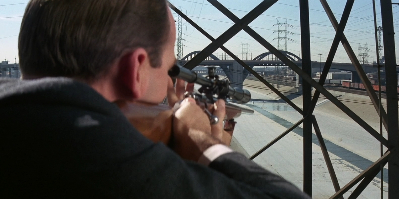
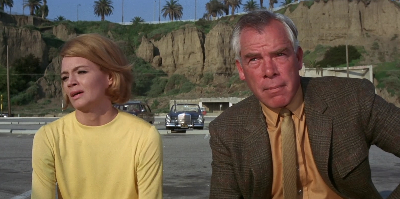
Where those later films were fantasies of mist and mystery, Point Blank is grim and sharp-edged, from Parker’s footsteps echoing down the corridors of LAX as he comes closer, shots fired and rage spent as he arrives to find the wreck of Lynn (The Mark of Gideon’s Sharon Acker), filled with regret, all other feeling burnt out of the two of them, the only spark of life the beautiful but cynical Chris (Dressed to Kill’s Angie Dickinson).
A powerless pawn equally full of rage which exhausts her where it drives Parker, dressed in gold against the bitter resentment which clouds even the California sunshine, she is a possibility of a brighter future where Parker is caught in the past, unable to progress until he has completed his task, fragments of violent encounters playing in his mind, raising the question of whether this is the revenge fantasy of a dying man in his last breaths.
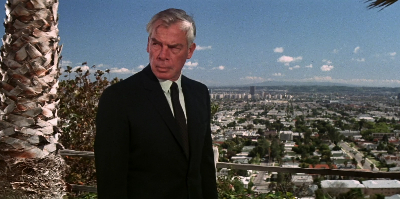
His escape from the treacherous waters of Alcatraz conspicuously never explained, Point Blank is occasionally hypnotic and abstract but always taut, Marvin’s restraint punctuated with moments where he abandons all control, the silent but dangerous centre of gravity around whom the others are forced to move even as they try to resist him, the rich who perch atop the hills and look down on the city and their cheap hired guns spiralling together as they vanish downcurrent.
Criterion’s 4K digital restoration of Point Blank supervised and approved by director John Boorman, it comes with an armoury of supplemental material, a conversation with Boorman at his home, a commentary featuring Boorman and Steven Soderbergh, an archive location documentary, a visit to the iconic locations as they are now, many immediately recognisable, and Marvin’s 1970 appearance on The Dick Cavett Show alongside guests Jeanne Moreau and Truman Capote.
Point Blank is available on Blu-ray from Criterion now