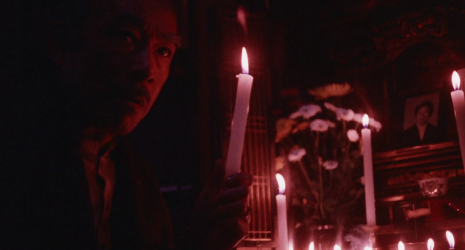
The Crazy Family
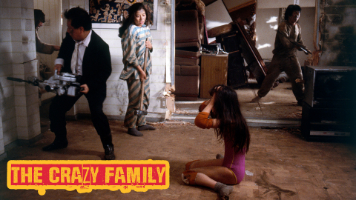
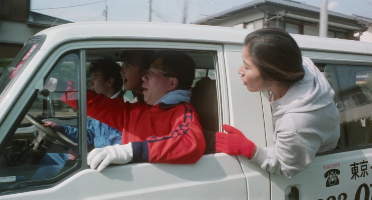
It has long been an aspiration of Katsukuni Kobayashi now achieved, to move his family out of their “inhuman public housing” into their very own home, he driving the white van to their new residence with his son Masaki beside him while wife Saeko and daughter Erika sit in the back, singing karaoke, the truck of all their belongings close behind.
Katsukuni hoping that the move will free them from the burden which he carried, their first step to a higher social standing, believing that his lack of achievement within the prestigious company at which he works has impacted his family, their behaviour changes, Saeko showing off at the housewarming party, Masaki becoming withdrawn and focusing on sound experiments, and Erika obsessed with her future career as a pop idol.
Released in 1984 and directed by Gakuryû Ishii from a script co-written with Norio Kaminami and Yoshinori Kobayashi, Katsuya Kobayashi is Katsukuni, patriarch of The Crazy Family (逆噴射家族, Gyakufunsha kazoku), more literally “backwards family” or “screwed up family,” with Mitsuko Baishô, Yoshiki Arizono and Yûki Kudô as Saeko, Masaki and Erika, the focus less on the quirks of the family members, why they are acting this way, than the blind alleys pursued over addressing their neglected needs.
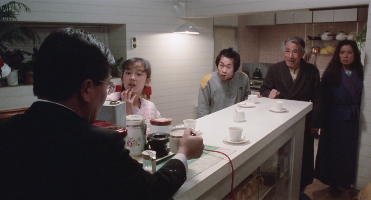
Katsukuni’s father Yasukune (Hitoshi Ueki) moving himself in without invitation, preferring his son’s home to his own, Katsukini sees it as his duty to accept the inconvenience and burden as part of his duty to his family in the competitive Japanese society, juggling obligations as he attempts to rearrange the household, Saeko furiously suggesting perhaps she could move into the doghouse.
An erratic madcap comedy which works best in contrasting traditional representations of family and culture in Japanese cinema, The Crazy Family may have had impact both at home and in the wider world forty years ago but is now dated, inconsistent and overlong, the characters thin and the chaos created by Katsukini’s shortsighted actions and refusal to suggest compromise or just take charge increasingly repetitive and exhausting.
Katsukini fearful of “diseases of civilisation,” the satire is blunt, the recurring theme of rot within signified by the white ant infestation found when the living room floor is ripped out to make a new basement, pesticides and fire used in the effort to rout them, and presenting the battered facade of success of a supposedly happy family it is inevitably Saeko acts as peacemaker when the dust settles, resuming domestic duties in the ruins before even those are pulled down.
The Crazy Family is streaming on Arrow now