The Odyssey
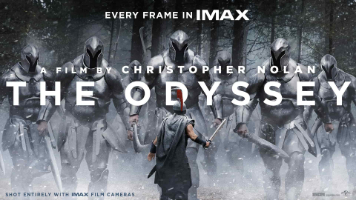
It is no exaggeration to say that The Odyssey is one of the foundational texts of literature dating to around the 7th century BC and believed to have been created by the Greek poet Homer who also composed the Iliad, its story passed down verbally by recitation in ancient Mediterranean lands, eventually written down, translated and adapted many times in different forms, its ideas and motifs becoming common parlance: “Beware Greeks bearing gifts.”
Parts of the story generally familiar to modern audiences while others were fully known only to experts in the field, scholars of early texts, simultaneously the language of the epic story found its way into everyday usage, an odyssey a great and challenging journey which will change the person who undertakes it, named for Odysseus, King of Ithaca, his good friend who teaches his son and watches over him Mentor.
Writer and director Christopher Nolan’s career having begun late in the last century, with each successive film he has expanded in complexity and daring, exploring non-linear narrative with Memento, isolation and confusion with Insomnia, compromised and driven heroes in his vision of Batman, dreams within dreams in Inception, world-ending apocalypse and journeys to strange worlds in Interstellar, linked overlapping narratives of attack and escape in Dunkirk and the echoes of cause of effect in Tenet, all themes reflected in The Odyssey.
His most ambitious film, shot entirely in IMAX 70mm cameras around the world, in Morocco, Italy, Scotland, Iceland, Malta, the Sahara and of course Greece itself, the very land of Homer though the precise relation of his locations to the many islands is unclear and remains the subject of academic speculation two and half thousand years later, The Odyssey cannot in any way be regarded as an “authentic” experience, but it is a journey of imagination which echoes the descriptions as they are passed down to us.
Introduced as a time of apparent magic, it begins as the story of a man and a fleet, a trick and a war, shipwrecked and tempted by the soothing oblivion of the lotus petals the great king Odysseus (The Martian’s Matt Damon) holding little memory of how he came to shores of the island or found himself in the company of the nymph Calypso (Fury Road’s Charlize Theron) who healed him and now cares for him, unaware his crew are lost and his family await him.
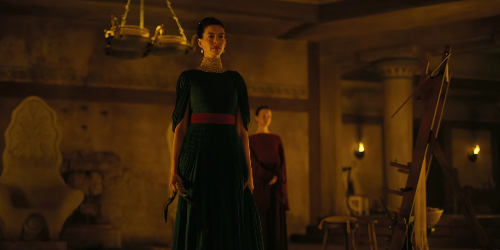
In Ithaca, the Trojan war is long over, many of the surviving soldiers returned home, the proud Queen Penelope (The Dark Knight Rises’ Anne Hathaway) raising her son Telemachus (Spider- Man’s Tom Holland) while obliged to maintain an open house to those who seek audience, the courtesy of “Zeus’ law” forcing her to tolerate the nobles though they are disruptive, boorish and greedy, mocking her for holding faith with a husband gone for decades.
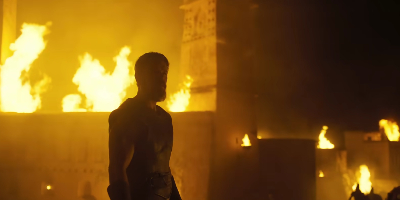
Penelope’s odious unwanted suitor Antinous (The Lighthouse’s Robert Pattinson) insinuating himself into the court, spreading dissent among her servants and separating her from her husband’s loyal friend Eumaeus (The Menu‘s John Leguizamo) and his aging dog Argos, thrown on a dung-heap, plotting a coup even as Odysseus slowly begins to remember, unaware he has been absent for twenty years or that his son is now seeking him on the waves he once voyaged.
The Odyssey a story which has reinvented itself countless times, passing into different cultures with some moments emphasised while the greater context is forgotten, not least from the films of Ray Harryhausen, the Cyclops and the Sirens echoed countless times through other myths, to have them reassembled into a singular whole is a revelation, fragments of memory coming together to form a coherent text in the same way as archaeologists gather shards of a pottery or a uncover a mural, Odysseus’ memories illuminating his muddy past as they return through the comforting lotus haze.
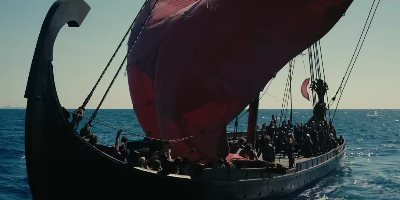
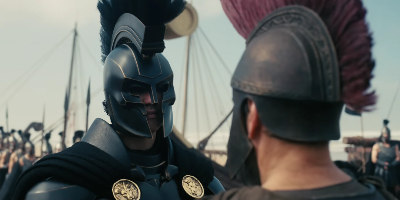
Believing himself to have been a good man and leader, always standing by his men on the front line, willing to put himself in the way of danger, his belief in his pure nobility and righteousness is tarnished, his principles betrayed and his faith lost along with his men, sometimes sacrificed on his orders to save others, while the words of his loyal friend Sinon (Flatliners‘ Elliot Page) taunt him from beyond the grave and he is haunted by Athena (Dune’s Zendaya), the gods capricious and vengeful when they are dismissed, offended or defied.
Those he meets such as the witch Circe (Minority Report’s Samantha Morton) rightfully afraid of what he has become, the “men of the sea” an enemy who has penetrated within the gates even as his own rivals do the same at his own hearth in Ithaca, The Odyssey is an enduring tale of hubris and misguided ambition, of honour and deceit, which has informed generations of storytelling, stripped back to its elements on stormy seas and desolate beaches yet rendered anew even as it returns to an emulation of its original form.
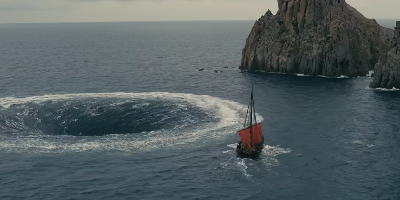
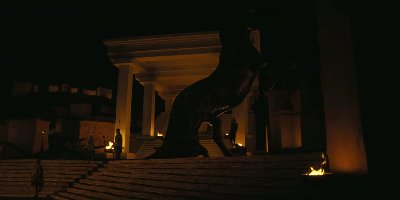
The majority of the iconic moments such as the elegant Trojan Horse created with thought as to how they would have functioned, the single remaining eye of the giant Cyclops is but one facet of its deformity, the only disappointment among the ancient wonders the unimaginative and mediocre Scylla of the rocks which plucks sailors from the decks, but it is the sole exception in an otherwise technically flawless undertaking, as would be expected of Nolan in his approach to what is likely to be considered his masterpiece.
Enthralling and encompassing, epic yet intimate and built upon the oldest of tales of long ago in strange and foreign lands and supported by an international A-list cast which also features The Force Awakens Lupita Nyong’o and Pilgrimage’s Jon Bernthal as Helen, resplendent as the most beautiful woman in the world whose abduction sparks the Trojan war, and her warrior husband Menelaus, the accessible translation ensuring that the story comes alive once again for a modern audience, enraptured as were those sat by the fireside thousands of years before.
The Odyssey is on general release now and also screening on IMAX