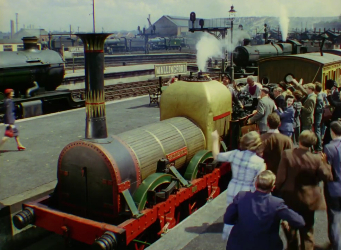
The Titfield Thunderbolt
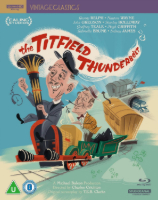
It is the Darwinian principle that life endures and advances through competition, that which is most capable and adaptable having the advantage, but there is deeper complexity for there are also benefits to be found in cooperation, in community, and in fact those who refuse to abide by the rules established for the greater good run the risk of becoming pariahs, even imprisoned or exiled from the protection of the herd.
With the rail network nationalised under the banner of British Rail and alternatives available such as the bus service run by the local firm of Pearce and Crump, it has been ascertained that the rural branch line running from Titfield to Mallingford is superfluous, redundant and above all unprofitable, the decision made to close it in June 1952, to the delight of Pearce and Crump who see a monopoly, but to others it presents an opportunity.
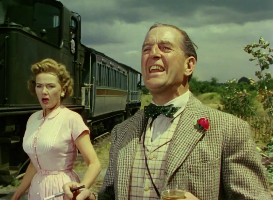
Directed by the great Charles Crichton whose diverse career ran from Dead of Night to A Fish Called Wanda via The Avengers and Space: 1999, he was at the controls of the cab of The Titfield Thunderbolt, the steam engine stoked by writer T E B Clarke and with Stanley Holloway, George Relph and Hugh Griffith on board as Walter Valentine who bankrolls the operation, rail enthusiast vicar Sam Weech and reluctant driver Dan Taylor, two of the three borderline alcoholics but only one a poacher.
With Sid James close behind in his steamroller as Harry Hawkins, hired to sabotage the new enterprise which will see the line purchased and run by a local consortium, granted a thirty day lease by the ministry to prove their merit and demonstrate safety and efficiency, The Titfield Thunderbolt is not only a tale of rural community spirit against faceless bureaucracy located miles away but communism versus capitalism.
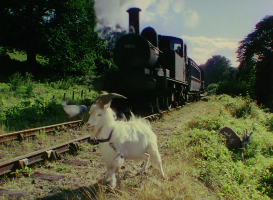
The needs of the people undermined by the greed of those who have no qualms about breaking the law in order to profit it was the first Ealing comedy to be shot in Technicolor, Saraband for Dead Lovers a historical drama, filled with saturated rolling green fields and forests, a celebration of idealised England, of unspoiled countryside where cows and goats roam freely and rivers are clean, that country air meaning the villagers are strong and healthy, capable of carrying, pulling and pushing heavy machinery at the drop of a flat cap.
The new edition of The Titfield Thunderbolt restored from the original three-strip camera negative, it includes a British Pathé short, cinematographer Douglas Slocombe’s 16mm films from location with commentary, a 2012 interview with Slocombe, around his hundredth birthday when it was recorded but lucid, garrulous and informative, reflections from Tim Dunn and a “making of” as well as a look at the Lion which played the Thunderbolt and a brief silent look at the locations as they are now, the railway line long gone and overgrown.