
Sherlock Holmes: The Death and Life
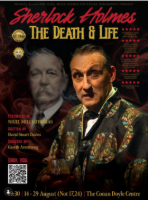
A hat stand adorned with scarf, top hat and requisite deerstalker, a small writing desk and many lit candles, on the mantelpiece, on the upright piano, on the hardwood floor, casting shadows across the tall walls and high ceiling; this is a place of contemplation, of study, a sanctum, yet at this time there is consternation, Doctor Conan Doyle growing tired of the creation whose fame eclipses his own reputation – and ego – and having told the editors of The Strand Magazine that Sherlock Holmes is destined to die.
Writer David Stuart Davies, director Gareth Armstrong and actor Nigel Miles-Thomas having previously explored the character, his cases and his complexity superbly in The Last Act, the mirror now shifts to explore the outer world, the relationship of the novelist and his alter-ego and the attempt to wrest control over it by extinguishing it in Sherlock Holmes: The Death and Life, performed appropriately in the grand upper floors of Arthur Conan Doyle centre in Edinburgh’s prestigious west end.
Switching between the roles of Holmes and Conan Doyle, the author disparages the consulting detective, calling him, not unjustly, arrogant and supercilious, concerned that he is developing a life of his own, and here he is, haughty, aloof, undeniably a genius of observation and deduction and determined that everybody in the room should know it, yet blind to the consequences of his own actions, disgruntled that John Watson should apparently prefer to spend time with his wife rather than chronicling Holmes’ cases and unable to comprehend why Mrs Hudson has become so abrupt when dealing directly with Holmes rather than via the intermediary of his companion.
Miles-Thomas an enthusiastic and eccentric Holmes, tall and dressed in black, his cape flapping as he stalks through the seething fog which shrouds the dark waters of the Thames, his voice is magnificent as he mourns the lack of challenges in his life, while in the gaps between the lines is James Moriarty, the means of execution, a plot device of targeted elimination devised by the equally but more obviously grumpy Doctor Conan Doyle, hoping to write a new future for himself but caught in his own trap: “a character that doesn’t really exist can’t really die.”


