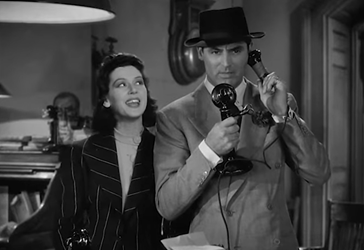
His Girl Friday
It’s farewell to the old job as a newspaper reporter, farewell to the offices of the Morning Post and all her friends who still work there and most specifically farewell to her old boss and ex-husband, editor Walter Burns, as Hildegard Johnson prepares to walk out the door on the arm of her fiancé, insurance salesman Bruce Baldwin, tidying up loose ends before catching the train to Albany where they were start their new lives of quiet, calm sanity.
Walter not a man who is accustomed to being walked out on or being told no, he is underhanded and wily, inveigling his way into Hildy and Bruce’s lunch date and trying to land them with the bill then asking Hildy to cover one last story for him before leaving, death row prisoner Earl Williams previously given reprieve by the governor for psychiatric assessment but with execution now set for the following morning, one hour to interview him and one hour to write it up, still plenty of time to get to the station…
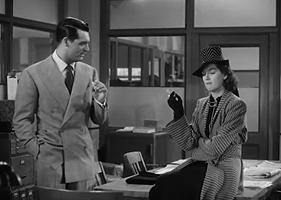
A play by Ben Hecht and Charles MacArthur first staged in 1928 then filmed under its original title, The Front Page, directed by Lewis Milestone in 1931, it was only nine years later that a second version was adapted by Charles Lederer as His Girl Friday, directed by Howard Hawks and with Cary Grant, his leading man from Bringing Up Baby, as Walter Burns and Rosalind Russell as Hildy Johnson, “Hidebrand” in the original and the role switched to a woman to add further complications and entanglements.
Pitching the wit of Walter and Hildy against each other, she determined to escape to her new life and he contriving schemes to keep her around, His Girl Friday falls firmly in the screwball mode of the romantic comedy which thrived in the thirties and forties, the dialogue fast, the situations contrived yet believable but rapidly escalating out of control with each out-of-the-blue twist, false leads, counterfeit cash, jailbreaks and a hostage situation.
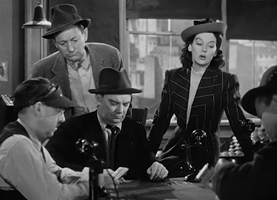
Jumping through genres, with puns and slapstick and a broken fourth wall, Bruce described by Walter as resembling the actor Ralph Bellamy when he is in fact played by Bellamy then referring to a story about Archie Leach, Grant’s own birth name, it is woven through with the genuine drama of the situation, the tragedy of down-on-his-luck Earl Williams (John Qualen) who accidentally shot a policeman and sparked a political witch hunt and sincere but broken Mollie Malloy (Helen Mack), the only person who has stood by the condemned man.
The play remade a further two times in the following years, as The Front Page in 1974 with Jack Lemmon and Walter Matthau and directed by Billy Wilder and then more loosely as Switching Channels in 1988 with Burt Reynolds and Kathleen Turner, it is the 1940 version which is regarded as the definitive, a production both ahead and of its time, bold, sharp, unrelenting, raising questions of capital punishment, lack of support for those marginalised by society and corruption in those employed to enforce the law.
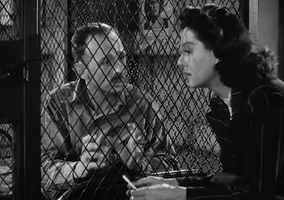
This is not to say it is not without issues, also products of the time, Walters manipulative and duplicitous and perfectly willing to trample over those who stand in his way to get the story and the woman even though she has repeatedly and unambiguously told him no, cinema of the age when the man always knows better than the woman what she wants and needs, Hildy’s eventual capitulation a fait accomplit obvious from the opening scenes, a frustrating affirmation to the expectations of the genre when elsewhere the film has fought against them.
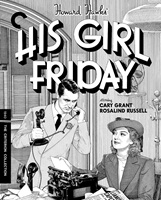
Joining the Criterion Collection, the special features of the new edition of His Girl Friday are also headline news, with the feature on both 4K UHD and Blu-ray and third Blu-ray with the 1931 version of The Front Page in addition to three radio adaptations of the various iterations, archive featurettes and an interview with Hawks, an interview with film scholar David Bordwell, trailers, essays and more.
His Girl Friday is available as a 4K UHD/Blu-ray double disc set from Criterion now