The Assassination Bureau

Miss Sonia Winters is assured, unflappable and direct, a woman of stern stuff as appraised by Ivan Dragomiloff, chairman of the Assassination Bureau Limited, specialists in removing specific individuals from society whom the world would be better off without, having jumped through hoops of cloak and dagger in order to meet and secure a most unusual commission, the individual whom she wishes to eliminate none other than Dragomiloff himself.
Winters intending to write an expose for a newspaper, Dragomiloff accepts the assignment as a matter of principle and the fee of £20,000, announcing to his assembled associates that after a grace period of twenty four hours he will expect them to assassinate him or die in the attempt, unaware that Winter’s investigation is financed by editor Lord Bostwick, his own right hand man in the Bureau who wishes to take control of the organisation.

Directed by The Ship That Died of Shame’s Basil Dearden, The Assassination Bureau already had an overly convoluted history when released in 1969, adapted by Michael Relph and Wolf Mankowitz from an incomplete novel by Jack London based on a concept which he had bought from another writer, completed decades after London’s death in 1916 by Robert L Fish based in part on the notes of London’s widow but also with his own ideas and inclusions.
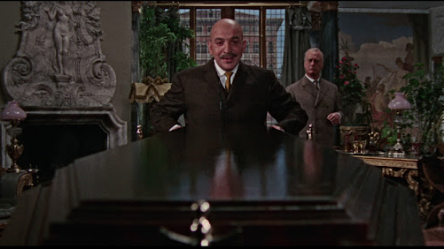
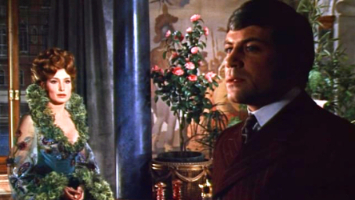
Colourful and opulent as it flits from London to sinful Paris, snowy Zurich to Vienna then Venice through location shooting, studio sets and rear-projection, it stars The Three Musketeers’ Oliver Reed as Dragomiloff, ruthless but charming and always a man of his word, Theatre of Blood’s DIana Rigg as Miss Winters, effortlessly cool but difficult to accept as naive after her decisive and defining role as Emma Peel, and Telly Savalas as genial and flirtatious Lord Bostwick, a far cry from the no-nonsense authority he presented in Horror Express and elsewhere.
An uneven film, The Assassination Bureau sometimes feels less than the sum of its magnificent parts, and it is possible a director such as Robert Fuest who worked on The Avengers and Dr Phibes might have given it more of a twist, but as a celebration of the age of Victoriana and a fantastical peek behind the conspiratorial curtains in the run up to the Great War a lazy Sunday afternoon watch worth the price of admission if only to witness Reed spanking Beryl Reid, certainly an influence on QED and possibly even steampunk and Robert A Heinlein’s “Committee for Aesthetic Deletions.”
Restored on Arrow for Blu-ray, the new edition of The Assassination Bureau is supported by a commentary from Kim Newman and Sean Hogan and a discussion from Matthew Sweet on its tangled literary history and its context in the varied cultural movements of the sixties, “dragging Victoriana into pop art,” a project frustrated by poor timing in the political turmoil of the era which led to it being perceived as “a catastrophic error of taste,” as well as a trailer and gallery.
The Assassination Bureau will be available on Blu-ray from Arrow Films from Monday 5th January