Dracula: The Night Around Us
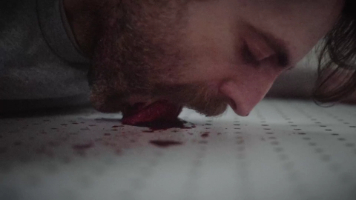
It is the last chance for Doctor John Seward and he knows it, his disgrace unspecified but now working with the criminally disturbed patients at Purfleet, termed a hospital but the barred windows and barbed wire on the high walls saying otherwise, his most challenging patient Renfield, convinced that blood is life and chewing flies with brown teeth which snap at those who come to close.
John living alone, he has new neighbours across the corridor, Mina, a young single mother, and her daughter Lucy, their first meeting abrupt but Mina overcoming her fears to express gratitude when John finds Lucy sleepwalking in the underground parking garage and brings her home, nocturnal wanderings which persist as though she is being summoned.
Written and directed by Chris Schwab with acknowledgement to Bram Stoker for the original novel as source material, Dracula: The Night Around Us is a minimalist adaptation, stripped down to only one segment of the narrative with Seward, Renfield and Mina (Eric Toms, Marlene Mc’Cohen and Spencer Weitzel) under the thrall of the hideous shape lurking at the edge of darkness and its more comely emissaries.
Dracula a sprawling and wordy text of castles, countryside, mansions and bustling cities, the minimalist approach is one that many stage adaptations have taken, unable to compete with the costumed extravaganzas of Coppola or Eggers, the closest parallel Herzog’s Nosferatu: Phantom der Nacht, at times almost wordless and still, frozen in fear and despair, the white walls of the sparsely furnished apartment a contrast to the impenetrable dark beyond.
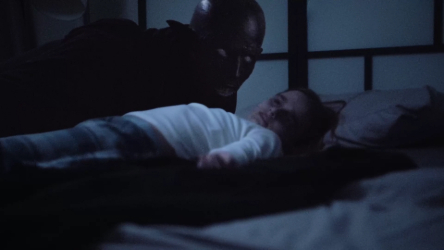
The visual arrangement of Mina waking to see the burned, batlike Dracula (Brenton Jones) crouched over the helpless and paralysed Lucy (Raelan Mackiewicz) echoing back to Murnau’s original, the setting in time and space is unclear but likely the late eighties, pagers rather than mobile phones, the opening scene set on the highway through the Borgo Pass which overlooks the city, unnamed but housing a significant correctional facility.
Shot in grainy soft focus, more Bigfoot than big budget, the slow pacing and languid editing consciously tie the film to another era of cinema, drifting dreamlike into nightmare, but while the leads are good and the experiment is interesting it was also the correct choice to limit it to little over an hour, peripherally engaging but bringing no fresh blood to a story already told countless times, a strange calling card to offer.
Dracula: The Night Around Us had its UK premiere at FrightFest