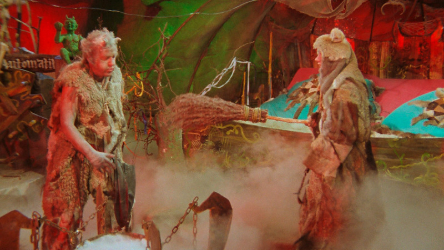
Into the Forest
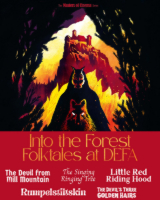
Eureka continuing their delve into the archives of the German state film company, their latest trove of treasure sees them moving Into the Forest, subtitled Folktales at DEFA, five films from the Märchenfilme genre, adaptations of popular fairy and folktales, some familiar from the work of Wilhelm Hauff, Hans Christian Andersen and the Brothers Grimm, others peculiar to their locality and never having travelled far into the world.
Comprising The Devil from Mill Mountain (1955, directed by Herbert Ballmann), The Singing Ringing Tree (1957, Francesco Stefani), likely the production if not the story best known of the quintet to an international audience, Rumpelstiltskin (1960, Christoph Engel), Little Red Riding Hood (1962, Götz Friedrich) and The Devil’s Three Golden Hairs (1977, Egon Schlegel), all are presented in restorations made by the DEFA Foundation with original German soundtracks and newly translated subtitles.
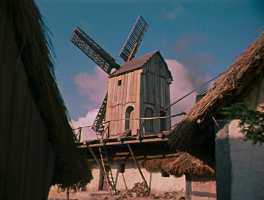
Set in the Harz Mountains where the gentle forest spirits known as “charcoal burners” watch over the humble villagers, among them Anne and Jörg (Eva Kotthaus and Hans-Peter Minetti), played by Willy A Kleinau The Devil from Mill Mountain (Der Teufel vom Mühlenberg) is a cruel and corrupt miller who wishes to have dominance over the entire area.
Plotting to burn the rival mill so all will be forced to take their grain to him, to play on superstition he disguises himself in a devil mask when he commits the deed, but when Anne is forced to work for him, her relatives no longer able to support, she recognises the stitching in the sacks of grain as her own, stolen from the mill before it burned.
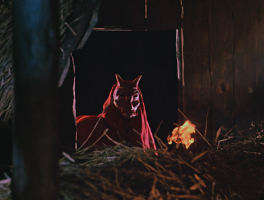
The three forest spirits Blackbeard, Redbeard and Melchior guiding and inspiring Anne and Jörg while conspicuously avoiding direct interference, The Devil from Mill Mountain is a strange walk through the forest, the characters and performances broad, marking it as a children’s fable, but with strong production values.
An ode to pastoral beauty and collective community action with forced perspective miniatures creating the distant mill at the foot of the valley and carousels of trees revolving to guide the lovers to their destiny, with impressive sets, lighting and colour and even a bird-singing contest, it brings a real sense of some distant kingdom where the trees hold magic.
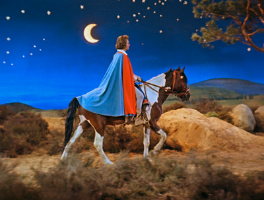
More consciously theatrical, almost surreal in its artifice but delightfully so, The Singing Ringing Tree (Das singende, klingende Bäumchen) opens with a handsome prince (Eckart Dux) on his way to court “the haughty princess” (Christel Bodenstein), dusk transitioning to night and the stars and crescent moon emerging above him before they meet and he is summarily refused.
His gift of pearls insufficient, her highness demands that he furnish her with the singing ringing tree before he is considered, the prince travelling to find and bargain for the mythical object, his overconfidence leading him to agree to the terms of the evil dwarf (Richard Krüger) who, when the tree is brought to the princess and does not please her, results in his transformation into a bear.
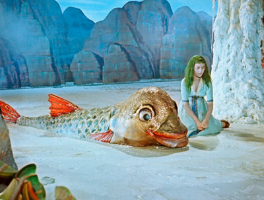
Another oddly magical kingdom, the sparseness and obvious artificiality of the sets from fields and caves to the blank walls of the castle where the king (Charles Hans Vogt) lives in fear of his daughter’s temper as much as the courtiers lends the whole the feel of a children’s storybook, half-imagined with the details left blank.
The princess vain and shallow but forced to learn kindness with expedience when she follows the prince and also falls under the curse of the dwarf, pining for silver baths and silk sheets but having to make do with the friendship of a large fish, the story and the lesson that a good deed is stronger than an evil spell are both thin but the production is oddly hypnotic.
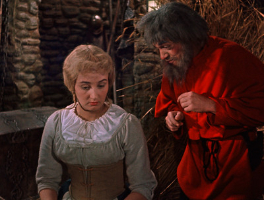
A name more generally familiar is Rumplestiltskin (Das Zaubermännchen, “The Magic Imp“), materialising to help to lowly Marie (Karin Lesch), daughter of Miller Kunz (Karl-Heinz Rothin) a prodigious liar who spins tales, berating his assistant Hans (Reinhard Michalke) and defaulting on the levy owed to the king (Nikolaus Paryla), promising the debt can be repaid by Marie who can spin straw into gold.
The filmed adaptation of an existing stage version of the story with pantomime costumes and flat performances of a hollow script notable only for some nice scene transitions, it is upon Marie that the imposition of her father’s irresponsibility lies, he becoming even more insufferable and lazy in his newly gained aristocratic position but she the one who is forced to perform apparent miracles and risk the life of her firstborn child.
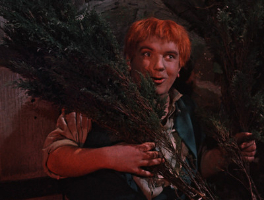
What keeps the wheel spinning is Siegfried Seibt as the crafty imp who neglects to introduce himself, most typically portrayed as malevolent and bad-tempered but here conspicuously guiding Marie through her difficulties, offering her chances to set things right and demonstrating to first her and then the king that love is more important than gold and greed and that lying is always wrong.
The many variations of the cautionary tale upon which it based slight and familiar and told from nursery onwards, Little Red Riding Hood (Rotkäppchen, “Little Red-Cap“) is obliged to take a route through the woods both long and complicated with many digressions, expanding beyond the young girl and her parents and her grandmother who lives across the forest, played by Blanche Kommerell, Helga Raumer, Horst Kube and Friedel Nowack.
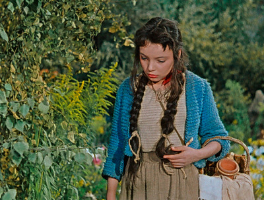
“A folk tale for small and big people” which opens with the requisite “once upon a time,” as well as the strong wolf (Werner Dissel) the woods are populated by a crafty fox (Harald Engelmann), and more amenable, Bear and Bunny (Ernst-Georg Schwill and Jochen Bley), anthropomorphic nightmares in furry suits all but also giving the best performances in a film which manages to be simultaneously well staged and absolutely tedious.
Grandma’s friendly squirrel fortunately a puppet less disturbing than the other forest dwellers who freely converse with the humans, Bunny sent across the meadows and thickets of the deep, vast forest to obtain milk, honey and powdered tobacco for Grandma, the latter of which Little Red Riding Hood uses as a weapon against the wolf, tormenting it before throwing rocks at it, this perhaps marks the film as an early snuff movie.
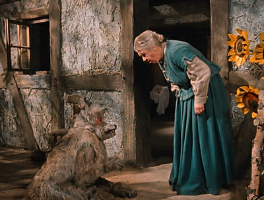
The closing film marking a significant change in direction, The Devil’s Three Golden Hairs (Wer reißt denn gleich vorm Teufel aus?, “Who would run from the Devil?“) is the first to use exterior filming in any way, taking in sunrise and forests, but actually becomes more interesting with the descent to the underground and a return to the studio, the secret chambers of the King then the journey to Hell itself.
Apprentice blacksmith Jakob (Hans-Joachim Frank) sent to the palace with a letter saying he is is to be immediately executed, it has been replaced with a fake saying he is to be married to Princess Rosalinde (Katrin Martin) who seems to be okay with the presumption, though her father (Rolf Ludwig) is less than enthused, issuing a challenge to the suitor that he must retrieve the Devil’s three golden hairs in order to win her hand.
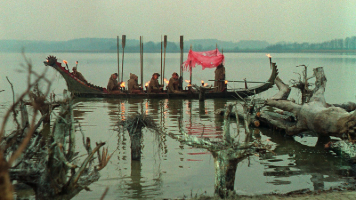
Playing like a sixties comedy, part Python, part Monkees, all childish, complete with dancing and pie fights in Hell, the Devil (Dieter Franke) is less sinister and more foolish, afraid of his wife and easily tricked, a figure of mockery as much as the members of the court, a fairytale farce of the people outwitting those presumed to lead them and rising with determination to every challenge unfairly placed upon them.
Supporting the five colourful features which are making their UK Blu-ray debut, Into the Forest also has three animations from DEFA, The Magic Scissors (1956, Bruno J Böttge), Sleeping Beauty was a Beautiful Child (1987, Katja Georgi) and The Wolf and the Seven Little Goats (1990, Otto Sacher), two commentaries, an interview with Fortean Times columnist Bob Fischer, a video essay by scholar Mary Goring on the depiction of the Devil in folktales and a sixty page booklet.
Into the Forest is available on Blu-ray from Eureka now