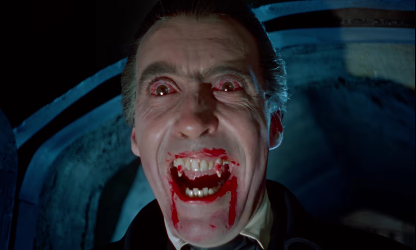
Dracula
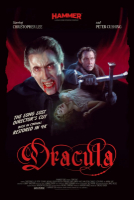
It was in May 1885 that Jonathan Harker reached the chateau in the mountains above the town of Klausenburg, arriving from his home in Karlstadt where fiancée Lucy Holmwood awaited his return, taking up the post of librarian to Count Dracula to catalogue his extensive collection but instead finding a note written in perfect copperplate instructing him to make himself at home.
Harker’s host not arriving until after dark, making an entrance from atop the stairs in his long black cloak, the visitor has already been assailed by a woman who begs him for assistance, saying she is a captive, confirming suspicions Harker and his friend Doctor Van Helsing harbour that this is a place of unspeakable evil, their mission to “end this man’s reign of terror forever.”
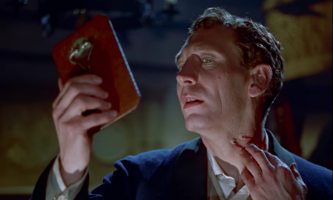
The iconic British studio Hammer having moved into colour the previous year with The Curse of Frankenstein, directed by Terence Fisher from a script written by Jimmy Sangster and starring Peter Cushing and Christopher Lee as his towering but mute creation, they reunited for Dracula in 1958, based on the novel by Bram Stoker but significantly rearranging characters and events, a conscious and deliberate retelling of the familiar in a different way.
Released in America as Horror of Dracula to avoid confusion with the Universal production of 1931 directed by Tod Browning and starring Bela Lugosi, that had been an adaptation of a 1924 stage version which maintained the story of the original but condensed events, F W Murnau’s 1922 Nosferatu, conveying great atmosphere even as it took liberties, not in general circulation having been withdrawn after legal action and not rediscovered until the following decade.
Sangster opting to relocate the whole to two villages only a few hours apart on horse, obviating the need for travel to England by sea, holidays in Whitby or a chase back across Europe, there are incongruous discontinuities introduced, the wet and ineffectual Harker (Four Sided Triangle’s John Van Eyssen) already aware of what Dracula is upon arrival yet woefully unprepared, killed before the arrival of Van Helsing in what is depicted as continuous action which is then stated to actually be early December, seven months later.
The audience acknowledged to be aware of Dracula, no effort is made to build him up as a supernatural evil beyond understanding, genial on his first appearance then hissing and biting thereafter, Helsing not presenting the convincing evidence of Harker’s diary to doubting Arthur Holmwood (Horrors of the Black Museum’s Michael Gough) until after the death of his sister Lucy (Brighton Rock’s Carol Marsh) by which time his wife Mina (Crucible of Terror’s Melissa Stribling) has also fallen under the vampire’s thrall.
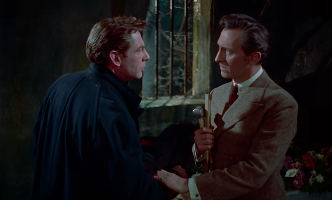
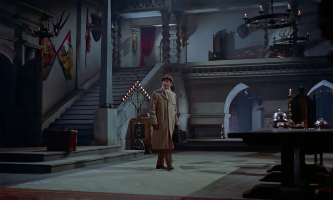
Lifted by the undeniable production values, the set of Castle Dracula which bookends the action vast with corridors, strange arches, staircases and the crypt where open sarcophagi lie, it is Sangster’s script which brings the whole down, Stoker’s bright and conversational characters reduced to functions, Lee in particular shortchanged, as he often was by Hammer, a tall form dominating from shadow but with no depth, The Devil Rides Out and The Wicker Man offering him better though it was Dracula which, to his chagrin, was his most famous and repeated role.
The blood which features in the opening titles looking like garish red paint, the staking of Lucy is more authentic, though it is the final dissolution of Dracula in the beams of sunlight penetrating his own library which are most effective in a film which otherwise plays as timid and quaint, the X certificate given it on original release now seeming based upon what was promised by James Bernard’s dramatically enunciated fanfare rather than what was actually delivered.