The Man Who Fell to Earth
His arrival unwitnessed, he wandered on uncertain feet down the mountainside, a man out of place in the desert sun in black jacket and red hair, unaccustomed to traffic and mannerisms, nothing so strange to a newcomer as smalltown America, Thomas Jerome Newton hawking his gold wedding ring for $20 cash to add to the secret wad of bills he keeps tightly rolled.
Sufficient gathered for a seed fund, he eventually approaches lawyer Oliver Farnworth with sketches of revolutionary electronics technologies, the patents launching World Enterprises which becomes a global brand, Farnworth nominally in charge while Newton is silent partner, a near-recluse who maintains oversight and control, his life “not a secret but it is private.”
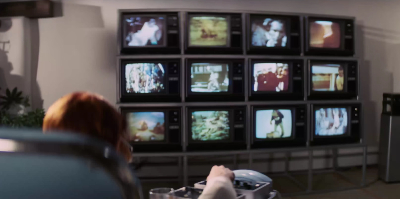
Living in “land of enchantment” New Mexico with Mary-Lou whom he met when she worked at the hotel he stayed at anonymously, she taking care of him when he became violently ill with motion sickness in the manually operated elevator, Newton is a man with a singular purpose from which he is increasingly distracted, by her, by alcohol, by the barrage of the media, a stranger entranced by the alien culture in which he finds himself.
Based on the 1963 novel of the same name by Walter Tevis, adapted by Paul Mayersberg, David Bowie was The Man Who Fell to Earth, directed by Don’t Look Now’s Nicolas Roeg, the first lead film role for the chameleonlike performer who consciously does not act as the visitor Thomas Jerome Newton, observing and reacting but always at a remove from those around him, his business dealings overseen by Farnworth (Buck Henry) with chemistry professor Nathan Bryce (Rip Torn) handling research.
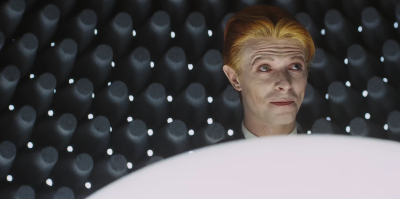
A film of alienation and the corrupting influence of society, the temptations thrown at Newton, it is some ways a parallel to the rise of David Bowie, artiste rock star in the indulgence of the seventies, while the vested interests of the corporate world see him as a threat which must either be brought into the fold to be exploited or destroyed, an indecipherable golden goose haunted by memories of his home and family left behind, his promises to return.
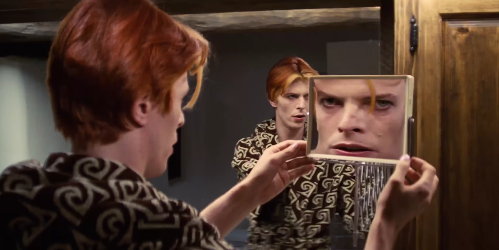
The Man Who Fell to Earth able to perceive beyond linear time on this “Planet of Water,” can he see his own future or only the past, forever examining himself in mirrors before choosing to reveal himself to Mary-Lou (Candy Clark), initially shocked beyond words but returning to her former self, needy, clingy, vapid, perpetually doused in gin, an excuse for him to fail in his task as much as she has failed in life, the status quo of stagnation maintained.
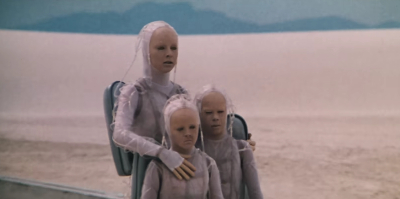
An abstract film which casually sidesteps the complexity of interstellar travel, the panoramic aerial landscapes recall 2001 while the immediate and long-term influence of the film can be seen in Children of the Stones, The Martian Chronicles and Under the Skin, Newton neither an astronaut nor a scientist but needing to be both in order to save his people, Elon Musk with shy, fragile genius replacing vanity and hubris, an inevitable tragedy of slow decline as his will is sapped.
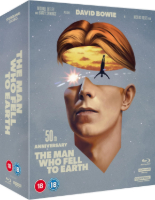
Joining StudioCanal’s Vintage Classics collection for its fiftieth anniversary as a box set of one 4K UHD, two Blu-rays and two discs of the soundtrack curated by percussionist Stomu Yamashta and The Mamas and the Papas’ John Phillips, The Man Who Fell to Earth is supported by a new documentary and a plethora of interviews including Roeg, Clark and Mayersberg and Bowie himself on French television from 1977, a hundred page booklet, artcards, photo cards and posters.