Innerspace
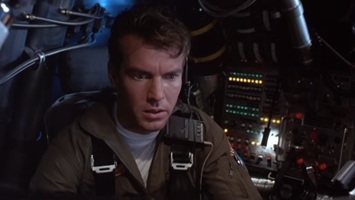
Lieutenant Tuck Pendleton has a problem; drinking too much and a joke amongst “the best and brightest” of his Air Force peers, he is on the outs with his on-off girlfriend, reporter Lydia Maxwell, and with no one else willing he has volunteered for a dangerous experiment conducted by Doctor Ozzie Wexler which will see him piloting a self-contained submersible, miniaturised and injected into a rabbit.
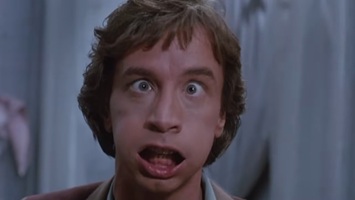
Jack Putter has a problem: suffering from headaches, a rash and persistent nightmares, his doctor believes it is anxiety and stress, recommending he take two weeks off from his job at the supermarket and go on a cruise, to relax with absolutely no excitement, a plan which is swiftly derailed when sabotage at the lab sees Wexler flee with the hypodermic containing the submersible, injecting it into Jack.
Joe Dante’s fifth solo feature film, originally released in 1987, Innerspace was the director’s second collaboration with Steven Spielberg as executive producer and ranks second in box office success to their first, 1984’s Gremlins, written by Jeffrey Boam and Chip Proser though quite obviously a remake of 1966’s ground-breaking science fiction adventure Fantastic Voyage, directed by Richard Fleischer from a script by Harry Kleiner.
The tale of a team of scientists and doctors attempting to save the life of an injured Russian defector from the inside unaware there is a traitor in their midst, here the threat is external and the subject is conscious though unprepared for his life to be hijacked and to suddenly being the target of hostile agents seeking the secrets of the experimental technology.
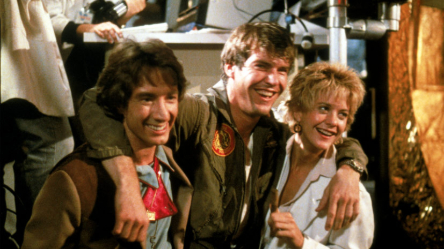
A golden couple of the following decade, it was on Innerspace that Dennis Quaid and Meg Ryan first worked together as Tuck and Lydia with comedian Martin Short bearing the brunt of the indignities as Jack, the ensemble a roster of Dante’s familiar friends in supporting roles, Robert Picardo letting his hair down as “the Cowboy” and Kevin McCarthy the sinister Victor Scrimshaw, alongside Wendy Schaal, Henry Gibson and, naturally, Dick Miller.
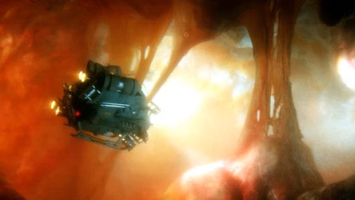
An unusual buddy movie, Innerspace shifts the wonder of Fantastic Voyage to manic energy and pratfalls, perhaps Dante’s most commercial film, playing to a broad audience, with little of the dark undercurrent that marked Piranha or The ‘Burbs, though like its predecessor it was honoured at the Academy Awards, winning Best Visual Effects for the interiors of Jack’s body, tissues, organs and blood vessels depicted with fascinating lifelike accuracy.
Despite NASA’s respectable Gentry Lee serving as scientific advisor, Innerspace is a tickbox of eighties summer tentpole cinema, noisy and brash with a leading man convinced he is irresistible, the shenanigans played out in Dante’s only film to foreground action over quirky characters and atmosphere, nostalgic for those who enjoyed it in the day but perhaps overlong to those on a first introduction.
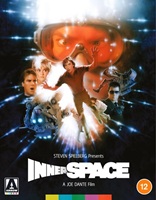
Arrow’s new restoration from the original 35mm negative approved by Dante, it is supported by a new and an archive commentary with Dante, McCarthy, Picardo, producer Michael Finnell and effects supervisor Dennis Muren, a new documentary, archive footage, storyboards, galleries, a trailer, a poster and a booklet with new essays on the film and the director and reproduction publicity material.
Innerspace will be available on 4K UHD and Blu-ray from Arrow from Monday 27th April