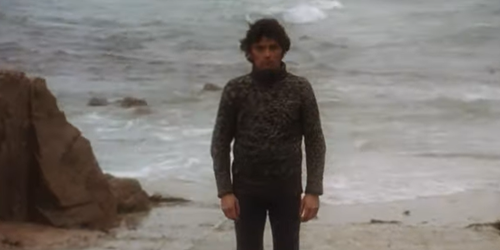
Neither the Sea nor the Sand
It is an escape for Anna Robinson, walking across the causeway to the lighthouse on the south west tip of Jersey, the winter waves of the English Channel battering the rocks, the wind in her hair and the birds wheeling above, a place of serenity and renewal, a place to be alone in her mind with her thoughts of her unhappy marriage, until she sees the man at the far end, waiting, almost sullen, yet slowly engaging with her presence.
Hugh one of the last of the Dabernons, once a prominent local family, now there is just him and his brother, the graveyard as full of their kin as the sea is of shipwrecks, the ghosts of the drowned sailors perhaps watching them; twenty years older and of deep faith, George does not approve of their relationship, so they leave for the similar coastal landscape of Scotland where Hugh suddenly collapses and Anna is overwhelmed, holding to a love which neither the sea nor the sand can end.
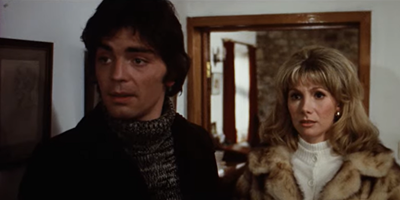
Directed by Fred Burnley and adapted by Gordon Honeycombe from his 1969 novel of the same name, the sense is that any illuminating inner monologue has been lost in translation, for even with “additional dialogue” credited to Rosemary Davies Neither the Sea nor the Sand is so sparse that it is questionable what might be left without those contributions, the relationship between Susan Hampshire’s Anna and Michael Petrovich’s Hugh almost wordless, both adrift and reaching out, becoming tangled with ease.
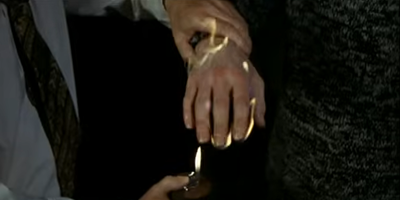
Hugh declared dead of a subarachnoid haemorrhage – without an autopsy and not by his own doctor, “the Lord’s judgement” on their adultery – it is to Anna’s relief when he returns late that night, confused but alive; deciding the diagnosis was mistaken, rather than seeking further medical advice to ascertain what caused Hugh to collapse or to explain why he is now mute, speaking to her only in her mind, they return to Jersey where George (Frank Finlay) accuses her of being a witch, setting fire to his revenant brother to prove there is no human feeling.
Filmed entirely in Jersey with the iconic La Corbière Lighthouse prominent, guiding the lost to an uncertain fate, and with Nachum Heiman’s haunting soundtrack recalling Rosemary’s Baby, as a stilted meditation on grief, Anna’s denial, bargaining and acceptance, Neither the Sea nor the Sand might hold water, but as drama or horror it lacks depth, Anna needy and clinging to a man she barely knows let loves truly, madly, creepy, the same era offering similar but superior films, Images, released earlier in 1972, and That Cold Day in the Park of 1969.
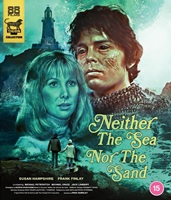
Presented on Blu-ray, the new edition of Neither the Sea nor the Sand is supported by two commentaries, by John Hamilton and Jasper Sharp and by Kim Newman and Barry Forshaw, interviews with Susan Hampshire, editor Norman Wanstall and standby propertyman Brian Lofthouse, Stephen Thrower discussing the film, an image gallery and a reversible sleeve featuring new artwork and the original poster.
Neither the Sea nor the Sand is available on Blu-ray from 88 Films