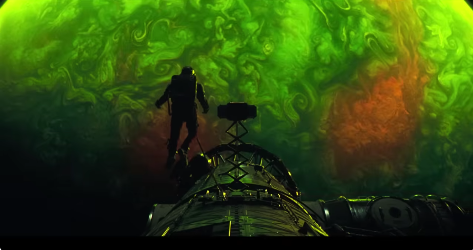
Project Hail Mary
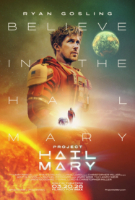
It is an awkward awakening for Ryland Grace, uncoordinated, struggling to stand or speak, gaps in his memory and condensation on the plastic cocoon which wraps him, his hair and beard out of control and the soothing voice of the computer offering little comfort in his confusion, the lights illuminating as he moves forward but the windows opening only on darkness, deep space and the stars.
A single bright point nearby which he wrongly assumes is the Sun, he retains his ability in maths and his memories slowly return, a schoolteacher whose novel theories published in his paper The Goldilocks Zone is for Idiots: Why Everyone is Wrong About Life saw him ostracised from the scientific community but brought his name to the attention of Eva Stratt, coordinator of Project Hail Mary.

The Sun slowly dimming, the true extent of the peril kept secret, it has been determined that it is due to an “infection” of an organism able to live in space, dubbed Astrophage; with the certainty that within thirty years the Earth will be devoid of vegetation as temperatures drop, other nearby stars are also dying with only Tau Ceti apparently immune, the spaceship Hail Mary sent across eleven light years to investigate, inevitably a one-way mission.
Based on the novel of the same name by Andy Weir and adapted by The Cabin in the Woods’ Drew Goddard and directed by Into the Spider-Verse’s Phil Lord and Christopher Miller, Blade Runner 2049’s Ryan Gosling is molecular biologist Ryland Grace, a good teacher but a reluctant astronaut, the only one of three crew aboard the ship who has survived the induced coma of the hypersleep, absolutely alone and with the fate of the world depending on him.
Capturing the spirit and style of the book better than Ridley Scott did with his adaption of Weir’s first novel, The Martian, the structure is maintained, the background of the mission and Doctor Grace’s induction into it revealed as his memories return, paralleling the discoveries at Tau Ceti, the complex physics and astrobiology made manageable broken down as school lessons, practical demonstrations and presentations.
Recalling Contact with a constant pace of investigation and analysis, fumbling forward in search of answers with only a few moments for reflection as Grace mourns crewmates he knows he knew but cannot recall, Gosling’s charm carries Project Hail Mary, necessarily condensed from the source material but without a sense of leapfrogging leaving holes, hard science fiction but a human story, a tiny spark of improbable hope in a cold dark universe.
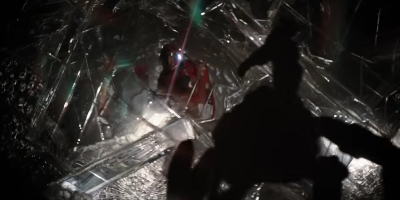
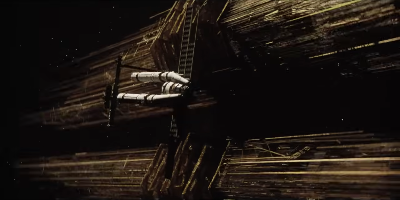
The mission-focused drive of Stratt (Proxima‘s Sandra Hüller) a contrast to Grace’s natural good humour, like Dark Star it is a film of loneliness and strange companionship in the depth of space with occasional country music, the interior of the Hail Mary fully realised and a contrast to the structure he encounters at Tau Ceti, an alien lattice spun from filaments of solid xenon, the first of many wonders which thrill and dazzle with cosmic beauty.
The giant leap to Tau Ceti made before the opening scenes Project Hail Mary is about the small steps which follow, the increments of understanding, communicating and collaborating which define the scientific process, teasing answers from cells and the cosmos, surprising, uplifting and rewarding, flying high alongside Sunshine and Interstellar as being among the best science fiction films of the current century.
Project Hail Mary is currently on general release and also screening in IMAX