The Man Who Haunted Himself
It would appear that Harold Pelham has a good life with his wife Eve, their two young sons and his job in the city, a partner on the board of marine engineers Freeman, Pelham and Dawson, their recent breakthrough in a new technology still a secret but one which is sure to bring them fortune, yet his marriage is stale and on the evening drive back to the listed building he calls home he has the urge to put his foot down and unfasten his seat belt.
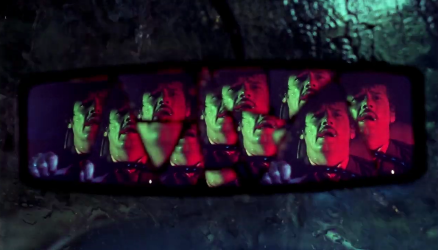
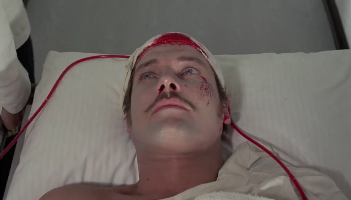
A miracle he survived at the speed he was going, that he was taken to the hospital rather than the mortuary, other than an oddity on the operating table where after being revived the monitor recorded two heartbeats, Pel makes a full recovery, yet his life is changed by strange occurrences, friends and acquaintances convinced they have seen him places he has not been, a doppelgänger interfering with his life and work.
The last film for Roger Moore, already a lead of television from The Saint, before he would become an international star when he took on the vacated role of James Bond in Live and Let Die in 1973, he is composed and conservative gent of the city Harold Pelham of bowler hat, suit, moustache and tightly rolled umbrella whose life unspools as The Man Who Haunted Himself, released in 1970 and based on The Strange Case of Mr Pelham.
Published by Anthony Armstrong in 1957 and expanded from his own short story of 1940, the adaptation was by Basil Dearden, Michael Relph and Bryan Forbes and directed by Dearden as his followup to The Assassination Bureau which served as his own final film, killed in a car accident the following year, an echo which adds an undeserved layer of interest to a film which shuffles towards a conclusion the audience grasped in the opening scene but never delves into the horror of a dissolving personality and an identity stolen.
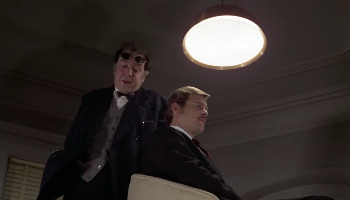
A tedious depiction of the frankly deserved disruption wrought upon wealthy and powerful middle aged men who negotiate takeover bids, preferential shares and voting rights, Moore’s limitations as an actor are unchallenged by the role of Pel, unimaginative, stuffy and passionless, his unleashed duplicate preferred by both wife Eve and lover Julie (Hildegarde Neil and Olga Georges-Picot), the endless foreshadowing at the club, the barber, the pool, the pool table and the hat check only delaying the damp squib of the finale which elicits no sympathy with its reconfiguration of the status quo.
A thriller without mystery or atmosphere but restored in 4K as part of StudioCanal’s Cult Classics collection, The Man Who Haunted Himself is given copious support with an interview with Kevork Malikyan who plays servant Luigi, an audio commentary from authors Jonathan Rigby and Kevin Lyons, an appreciation by Joe Dante and Stuart Gordon, a featurette, galleries, storyboards and a trailer and selections from composer Michael J Lewis’ energetic suite.