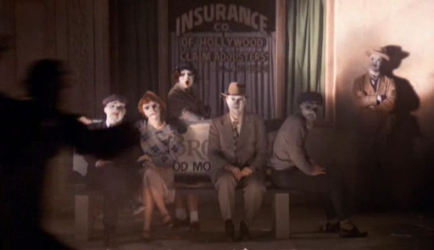
The Day of the Locust
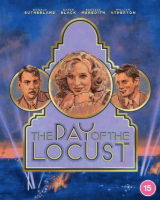
From across America they swarm to the sunshine state of California, to the dream of Hollywood, artist Tod Hackett taking residence at the “earthquake cottage,” the San Bernardino Arms in West Hollywood, a crack running down the wall from the big one of ‘33 which he papers over with sketches, talented and ambitious and determined to walk through the white arched gates which open onto the Paramount lot to begin his career.
Across the courtyard, Faye Greener lives with her elderly father Harry, a Vaudeville comedian who now peddles potions with tired song and dance routines, while she is a background extra who believes the spotlight always shines for her, acting like the star with every breath, a woman who is accustomed to receiving everything she asks for from men except the fame which eludes her, both she and Tod always on the lookout for an opportunity, a step upwards.
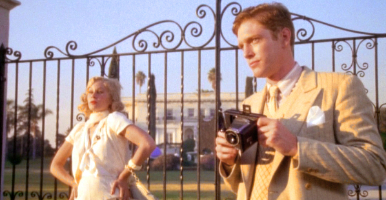
Adapted from Nathanael West’s 1939 novel by Waldo Salt, himself a victim of the system when he was blacklisted in the fifties and forced to work under a pseudonym, The Day of the Locust was directed by Midnight Cowboy’s John Schlesinger, a scathing film released in 1975 of sunshine and promises and the cracks behind the facade in a town which feeds on the freaks and damaged people but offers them no comfort or sympathy.
Starring Burnt Offerings’ Karen Black and Burgess Meredith as Faye and Harry, she is a spoiled one-woman party wagon who has to be the centre of attention, starving herself and demanding adoration, dressed in white silk as she feigns innocence while leading men on until she can determine whether they will be a step up for her: “I could only ever let a really rich man love me,” she says, but for now Tod (Die Hard’s William Atherton) will do.
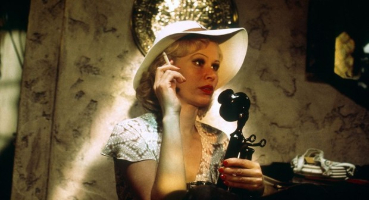
Convenient as nearby and working in film, he is tossed aside for Homer Simpson (Invasion of the Body Snatcher’s Donald Sutherland), smitten but hopeless, dull but financially stable, a roof over her head but a home with no love, Homer obsessing over Faye while she is repulsed by him, bringing it all down when she parades her passions and causes a scene, lashing out when she doesn’t get what she wants.
Her affection an act which she cannot maintain, it is as false as the sets built to Tod’s design on the Napoleonic epic film within the film directed by House on Haunted Hill’s William Castle, the location for that film Frank Lloyd Wright’s iconic Ennis House and also featured in The Day of the Locust, collapsing under the troops retreating up the plyboard hill, injury and liability brushed under the carpet by executive Claude Estee (The Thing’s Richard Dysart).
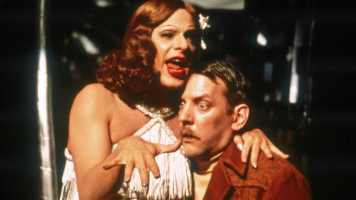
The news split between glossy premieres and troubles in Europe under Chancellor Hitler while groomed-to-be-a-star Adore (Damnation Alley’s Jackie Earl Haley) dances in the streets with equal parts glee and malice, an amalgamation of all that is fake, unnatural and monstrous, like the rising tide of discontent in Berlin when the locusts swarm they bring devastation, the chaos beyond anything created on a soundstage, the mecca of broken dreams luring in the needy and leaving them bleeding on the sidewalk.
Remastered in 2K from the original negative by Arrow, the new edition of The Day of the Locust is supported by a commentary provided by many of the crew, an appreciation by Glenn Kenny who considers the aspects of self-loathing and self-congratulation, a visual essay where Lee Gambin sees the characters as “dedicated but demented” and the film simultaneously part of and reflecting on the movie industry, and Elissa Rose on the glorious Oscar winning costume designs by Ann Roth which complete the tainted illusion.
The Day of the Locust is available on Blu-ray from Arrow now