Daleks’ Invasion Earth 2150 A.D.
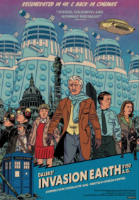
The nationwide impact of the introduction of the Daleks having secured the immediate future of Doctor Who on television, it was little surprise when they returned early in the show’s second season with The Dalek Invasion of Earth, six episodes written by Terry Nation broadcast in late 1964, nor that with their first encounter adapted as the feature film Dr. Who and the Daleks that the rematch would also receive a similar treatment.
Released in August 1966, in the brief interlude between the third and fourth television seasons, the latter of which would see the departure of William Hartnell in the title role having met the Daleks twice more already in The Chase and The Daleks’ Master Plan, adapted by Milton Subotsky and David Whitaker the script is tighter and the production stronger, Daleks’ Invasion Earth 2150 A.D. by far the better of the two films.
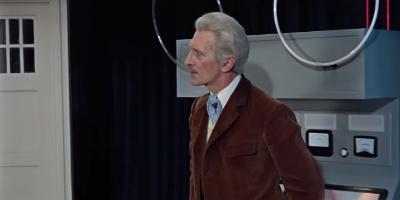
With Peter Cushing and Roberta Tovey returning as Doctor Who and Susan, younger than her television counterpart though in some ways closer to the “kid to get into trouble” she was first envisaged as, her youth means the romance which formed part of the original storyline is easily excised, and while seen only briefly, nor is the once haphazard interior of TARDIS, previously seemingly made of hanging wires and bits of plyboard, a more coherent mechanism.
Joining them are Jill Curzon as niece Louise and, introduced in a silent melodrama opening of jewel heists and explosions, Bernard Cribbins as Constable Tom Campbell, blowing his whistle and stepping through the doors of what he believes is an ordinary police box and thrown into another world, a strange and frightening future where he inherits the slapstick routines vacated by his predecessor Roy Castle, though in recompense Cribbins is the only actor ever to have played two different companions, albeit here in an “unofficial” capacity.
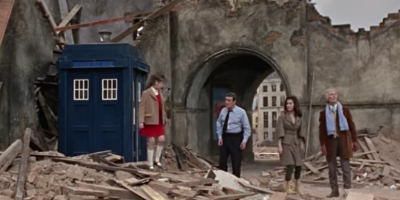
London devastated and apparently deserted, the adventurers are split up, falling in with a band of survivors who hope to develop weapons to fight the invading Daleks who use Robomen as enforcers, converted from the more intelligent of those they capture, the rest sent as slaves to an enormous mining operation in Bedfordshire drilling down towards the Earth’s core, though not in search of “Stahlman gas.”
With Philip Madoc as collaborator Brockley and Eileen Way as the old woman who lives near the encampment, he a purely self-interested misanthrope while she at least has motive for her betrayal making her more sympathetic, both made appearances in the parent show as different characters, and alongside Quatermass and the Pit‘s Andrew Keir as resistance fighter Wyler the superior supporting cast are given considerably more to do than in the first film.
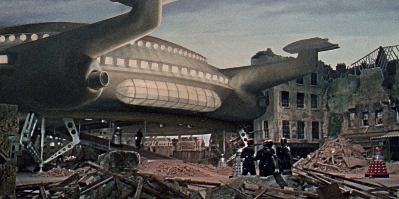
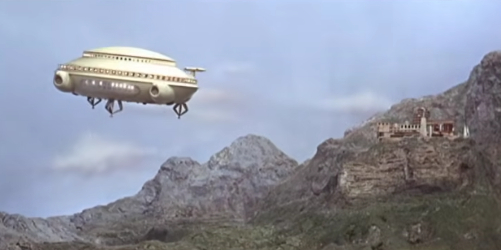
Director Gordon Flemyng bringing the menace home with familiar landmarks, the cyclorama of the London skyline and the matte shots of the Dalek spaceship, unintentionally iconic when it was mistakenly used on the cover for the paperback novelisation of the television story rather than the more conventional saucer of the original, the camera is more mobile and the sets are designed to allow more interesting shots, and the action is frequent though Bill McGuffie’s accompanying jazz attack score is questionable.
Cushing’s costume more subdued than on his trip to Skaro so less consciously anachronistic to draw attention to him, at least when he is not dressed in black PVC, Daleks’ Invasion Earth 2150 A.D. is compact and self-contained with little interest in explanations or wider mysteries, perhaps the best British science fiction adventure film of the era, albeit with the caveat that this is not a particularly crowded field.
Daleks’ Invasion Earth 2150 A.D. will be streaming on StudioCanal Presents from Thursday 2nd July to celebrate World UFO Day