Dr. Who and the Daleks
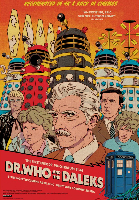
It seems strange now, in the day of Blu-ray restorations and the BBC iPlayer or its international equivalents that there was a time when an episode of Doctor Who, even one which remained intact in the archives, was still beyond the reach of the fanbase, repeats rare and only the immediately previous season usually considered so as not to confuse the general public by presenting previous Doctors or muddy the waters with monochrome.
It also seems strange, in an era when the lines between feature films and television series are blurred, Marvel and Star Wars tying narratives together across formats and The X-Files having a movie between seasons, albeit one which very studiously avoided advancing the overall plot in any meaningful way, that there was a time when the film adaptation of a television show was a very different beast.
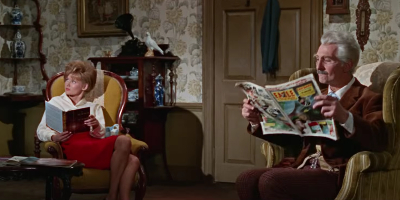
Intended to appeal to a different audience, possibly one unfamiliar with the source material, a film more easily imported to a territory where the parent show had not been broadcast, while sometimes a new script would be developed, as with Doomwatch, a remote investigator associated with the familiar London team, often it was an abridged adaptation of pre-existing teleplays, as with Hammer’s three Quatermass films, Callan and Dr. Who and the Daleks.
Originally broadcast from late December 1963, the seven episodes which comprise The Daleks by Terry Nation were brought from around a hundred and seventy minutes to eighty by Milton Subotsky, jettisoning any extraneous material while adding an introduction to Doctor Who (Peter Cushing), elderly inventor of time machine TARDIS (not “the”), his two granddaughters, Barbara and Susan (Jennie Linden and Roberta Tovey) and Barbara’s boyfriend Ian (Roy Castle) whose bumbling lands them in a strange time and place and swiftly in danger.
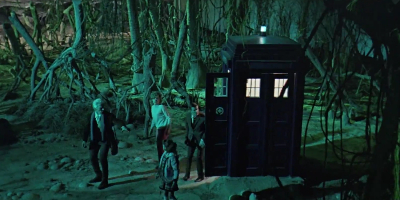
Dr. Who and the Daleks a strange parallel which recreates the original experience even as it diverges from it in numerous ways, and repeated often in the seventies and eighties for some the memory of the 1965 film intended to capitalise on Dalekmania was more vivid than the television episodes broadcast only once – if they had even seen them – and for many the only experience of the story other than David Whitaker’s paperback, the first Doctor Who novelisation published so also in part rewritten as an introduction.
Directed by Gordon Flemyng, with Cushing a familiar face in horror and science fiction cinema he was a natural fit for the part and other than body doubles the first actor other than William Hartnell to play Doctor Who, unknown at the time to be only one of many yet an unsurprising development now, though while his style of dress is retained he is not the same character, jovial, playful with Susan, more physical and while at times equally scatterbrained less prone to allow his temper to flare or belittle his companions.
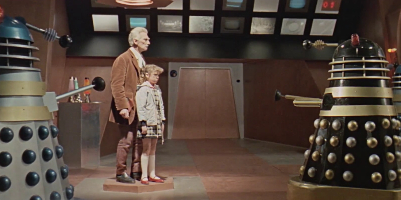
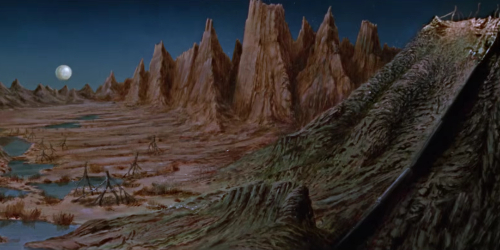
Barbara and Susan given only token involvement and the golden haired Thals bordering on useless, Ian’s role as comic relief is a concession to the format to appeal to the broad audience as is the dramatic score, more conventional than anything offered by the Radiophonic Workshop but while the scope of the production, the city interiors and the expansive dead forest, albeit with the cyclorama occasionally visible, is more than could be achieved on a television budget at the time, and crucially it is the first time the strange worlds of Doctor Who had been seen in colour, though the Daleks themselves feel less menacing and coldly ruthless than the biomechanical monsters mutated on an irradiated world of the original.
Iconic from their first appearance and retaining Raymond Cusick’s design but modified with bigger bumpers, enlarged dome lights and the change from video to film requiring their ray guns become practical steam jets, perhaps it was the colour which was the selling point that diminished them, never again as threatening until Genesis of the Daleks returned them to gun metal grey, Dr. Who and the Daleks an oddity but occasionally magical, consciously set apart from the television continuity but in many ways more coherent than the condensed colourised version of the story broadcast in 2023.
Dr. Who and the Daleks will be streaming on StudioCanal Presents from Thursday 2nd July to celebrate World UFO Day