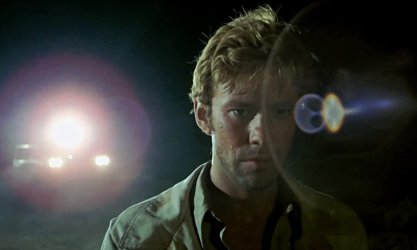
Wake in Fright
Schoolteacher John Grant is chained to his desk every bit as much as his students are tied to theirs, they required to fulfil the obligations of education and he the subject of a two year bond which will require him to forfeit $1000 should he break his contract, exiled to Tiboonda in the outback where the blue sky and dirty red sand are broken only by a few stunted trees and the railroad, stretching straight out in either direction but going nowhere, the sad faced children sat next to their older peers as they wait for the final bell of the term.
A six week break for Christmas under the sweltering sun, Grant takes the train to Bundanyabba, “a friendly place” where he plans to spend one night before flying back to Sydney but falls in with the “aggressive hospitality” of Jock Crawford who demands Grant drink, drink and drink, showing him around the low culture of “the Yabba” where he is introduced to the game of chance of two-up, onlooker Clarence “Doc” Tydon’s confidence persuading him the numbers are in his favour, Grant winning big before losing everything, stranded with no money and no exit.
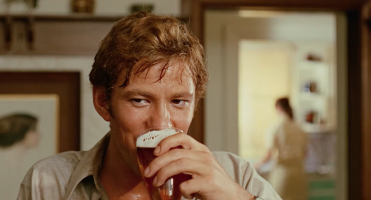
Based on Kenneth Cook’s 1961 novel of the same name, originally explored as a collaboration for Joseph Losey and Dirk Bogarde, it was not until early the next decade that production on Wake in Fright began in Broken Hill in remote far west New South Wales under the eye of Canadian director Ted Kotcheff, later responsible for First Blood and Weekend at Bernie’s, adapted by Evan Jones but with many of the lead roles played by British actors among the authentic locals, Gary Bond, Donald Pleasence and Sylvia Kay as Grant, Doc and Janette Hynes, throwing herself at Grant for attention, distraction or perhaps a chance to buy escape.
The inhabitants of the Yabba represented by Chips Rafferty, Jack Thompson and Peter Whittle as Crawford and Doc’s pals Dick and Joe, they are examples of raw Australian masculinity who assimilate Grant all too easily into their reckless excess, constantly drunk and roving the plains in search of transitory excitement or the next fight, everything a joke, a big game, instant gratification their only goal among the heat and sand, nothing to aim for but the roving ‘roos and nothing to lose, while Doc is a paradox, embracing primitivism even as he offers commentary on its emptiness: “All the little devils are proud of hell.”
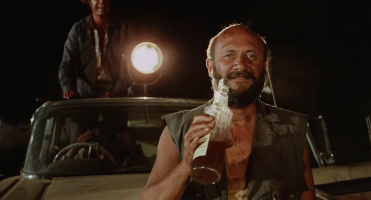
Doc an educated and capable man who has abandoned all he worked for to become the alcoholic outback philosopher, Grant’s initiation into the nihilistic trio over, he is carried along as they push each other further into bloodsports and dirt wrestling with no quarter, trapped in a borderless wide open space and dependent on those he despises and looks down on who in turn look to him as the outsider to justify their drinking, calling him out any time he wavers as though his resistance shows their own weakness and inability to control themselves, Australia a land claimed by invaders and convicts who displaced the people who belonged there and found only disappointment and dust.
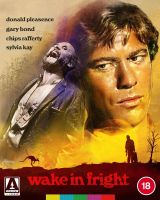
A dark, disturbing and increasingly homoerotic downward spiral through “the arrogance of stupid people” and its consensual consequences once thought a lost film with only a single damaged print extant until the negatives were found and restored in 2009 and now regarded as a defining film of the “Ozploitation” movement which continued through Mad Max, Wolf Creek, Wyrmwood and Rippy, Arrow’s new edition of Wake in Fright is supported by two commentaries, with Kotcheff and editor Anthony Buckley and with film writer Peter Galvin, a location feature, an appreciation of Pleasence, an interview with director of photography Brian West and other archive interviews, reports and items of interest.
Wake in Fright is available on 4K UHD and Blu-ray from Arrow now