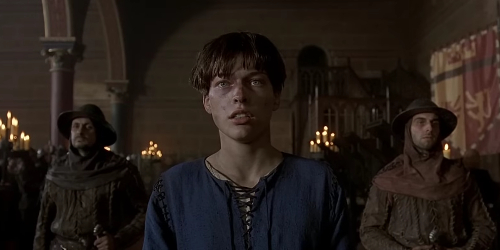
Joan of Arc
She was a girl from Domrémy in the north east of France, a happy child named Jeanne who loved her family but always felt safest in church, eager to be close to the God whose voice she heard constantly and of whom she had visions, a beautiful boy on a stone throne in the forest, a pastoral scene both idyllic and magical until storm clouds gathered over the village.
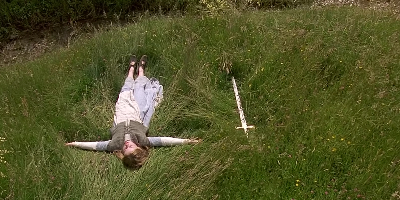
A sword in the grass, the wolves in the forest, the raiders burning her village, it was not a vision but a truth, Jeanne’s sister murdered and she sent to relatives where her religious fervour did not quell, the years passing and her conviction growing she was the messenger of God sent to repel the English invaders and put Charles de Valois, the Dauphin of France, on the throne.
Her reputation as “the peasant who wants to fight” preceding her, Charles’ mother-in-law, Yolande of Aragon, sees advantage in appeasing the superstition of the simple folk who believe this child to be a warrior of God, but Gilles de Rais, Jean de Dunois and Étienne de Vignolles, known as “La Hire” (“The Wrath”) are less convinced, marginalising Jeanne in the military campaign, with only knight Jean d’Aulon honouring the wishes of his king-in-waiting.
The stylish and manic science fiction action of The Fifth Element having brought director Luc Besson huge international success and acclaim, his next project reunited him with the star of that film, Ukrainian born former model Milla Jovovich, to play the iconic French heroine and martyr of the Hundred Years’ War Jeanne d’Arc, more commonly known in English speaking countries as Joan of Arc.
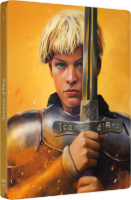
Released variously as The Messenger, Jeanne d’Arc or simply Joan of Arc, the film was in some ways complicated and compromised, an international co-production of a French icon but with the majority of the dialogue spoken in English and with many of the supporting actors English or American among a smattering of French notables, affronting the pride of the very nation where it should have had the most appeal and, like Jeanne in her eventual show trial for heresy, denying it a true appraisal.
With John Malkovich as flexible Charles and Faye Dunaway as crafty Yolande, spreading hope and malice as suits the court, Vincent Cassel, Tchéky Karyo, Richard Ridings and Desmond Harrington are Gilles, Dunois, La Hire and Jean while Timothy West leads the trial as Pierre Cauchon while Dustin Hoffman is the mysterious voice of Jeanne’s conscience, haunting, taunting, mocking and twisting her words.
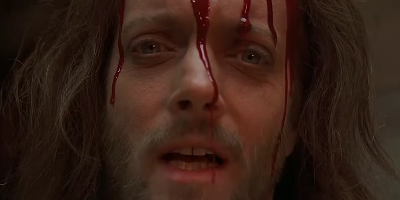
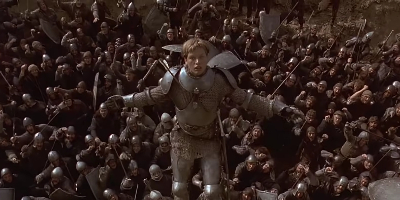
An undeniably handsome dramatisation rather than a documentary, the scale is epic with battles across the countryside of France with hundreds of costumed extras with siege weapons and bloody castle defences to repel them, a production as insane as possibly is the lead character, some saying she is an instrument of God and others a witch, a woman either beatific or possessed but with absolute yet humble devotion to the cause rather than her ego, Jeanne unwavering in her belief that she is delivering the message of God.
Winner of the Lumière Awards for best director and best film, now restored in 4K Joan of Arc deserves far greater attention and praise than it received in 1999, StudioCanal’s new edition supported by a feature documentary and a myriad of interviews featuring technical director André Labbouz, second unit director Gérard Krawczyk, César nominated cinematographer Thierry Arbogast, César nominated editor Sylvie Landra, César winning costume designers Catherine Leterrier and Olivier Bériot, César nominated production designer Hugues Tissandier and César winning sound designer Bruno Tarrière.