Sailing into the Unknown with Mark Jenkin
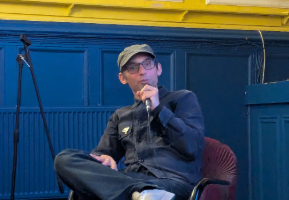
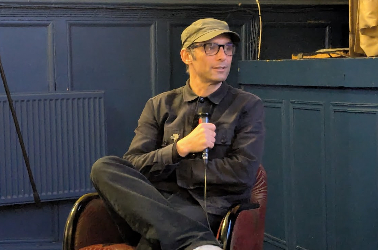
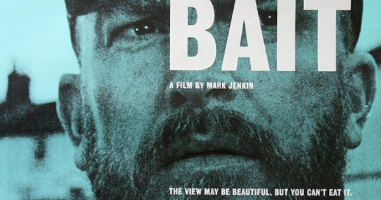
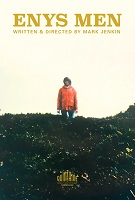
His film Rose of Nevada having screened at the Venice and Glasgow Film Festivals, Mark Jenkin, director of Bait and Enys Men, conducted a whirlwind tour in support of his latest in the week prior to its wide release, stopping at Edinburgh’s Cameo Cinema on the evening of Tuesday 21st April to host the screening and talk about the strange fate of the fisherman aboard the titular vessel who return to harbour to find themselves displaced in time.
Asked about the initial idea behind the film, Jenkin admitted he had been in a quandary when the pandemic struck, normally working on a three year schedule and preparing to shoot Enys Men when lockdown hit and his agent suggested in the interim he write something, but he had already had his one idea for that year and had nothing lined up.
His only thought being of a single scene of a ghost boat, all hands lost thirty years before, returning to harbour, but he had nothing beyond that to progress the story until his creative partner, Mary Woodvine, suggested that not everyone was surprised at the return.
Choosing not to write the idea down, to instead sleep on it and see if they remembered it in the morning, neither spoke of it until the next evening and found they had both been thinking about it, both agreeing it was worth progressing with, though Jenkin said he had subsequently been “living in fear it was an old Twilight Zone” he had once seen and forgotten.
The experience of the isolation profound, Jenkin described it as “an existential crisis – my brain worked in different ways,” but with cinemas closed there came a “weird abstract freedom to write something that will likely never get made,” Rose of Nevada reflecting those themes of “thinking about the future, mourning the past, trying to live in the present, jumping around time as your mind does… we’re terrorised by time.”
The crew of the trawler “unshackled in time, seeing it all,” Jenkin realised he needed an understanding of quantum physics so bought a book on the subject only to find out that “It turns out it’s really hard,” so instead they ordered the Quantum Leap box set, of which he said “It’s certainly not aged well. Dean Stockwell was always a bit dodgy, sneaking into women’s dressing rooms, and Sam is a time-travelling sex offender,” something which Rose of Nevada addresses, another influence being Goodnight, Sweetheart, which deals with a similar relationship paradox, albeit as a comedy.
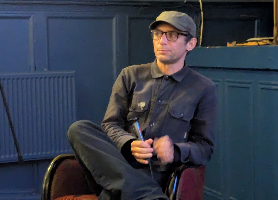
Moving onto the more technical aspects of his filmmaking process, Jenkin said “I like films that draw attention to the fact that they’re films – I like to push the audience’s suspension of disbelief.” Observing that the viewer knows it is a pretence, an artifice, yet still feels connection to a series of images which can elicit emotion and manipulate feelings, he said “I don’t know if that means we’re incredibly sophisticated or incredibly thick.”
Shot on 16mm with no location sound, all the dialogue re-recorded later (“No additional dialogue recording, only dialogue recording because it’s not additional”), the same “non-synch” process he used on Bait and Enys Men, on this occasion Jenkin worked with a supervising sound editor “who works on huge movies,” smoothing the process: “Third time so maybe I’m getting better at it.”
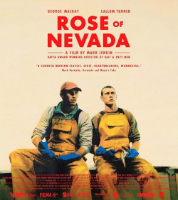
The leads played by George MacKay, who late in the process had to interrupt his daughter’s birthday party to send over a single line of dialogue which had been missed in the edit, and Callum Turner, Jenkin said it was the first film he had used his own voice, normally asked to play “posh or American” rather than his London accent.
His first three films having been set on coasts or islands, borders between here and there, Jenkins said he had indeed been accused of being “obsessed with water,” and accordingly his next project is landlocked, a road trip from New York to Wisconsin – though of course his protagonist will be Cornish.
Rose of Nevada is currently on general release