Doctor Who – The Movie
It is again a time of uncertainty with those who are in a position to know making little effort to downplay the concerns of the uninformed public, while those who profit from turmoil spread theories based on speculation or malicious disinformation calculated to outrage those most vulnerable, while in the background hidden wheels quietly turn, making sure all will be set right and the future will continue as it should.
History having a habit of repeating itself, thirty years ago, long before the concept of clickbait had monstrously birthed itself, things were both different and very much the same, Doctor Who having been more or less continuously broadcast since 1963 but off the air since 1989, now relaunched in a new form which was both exciting and concerning, an American co-production in conjunction with the BBC with none of the former creatives involved.
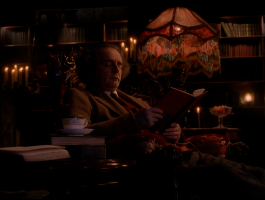
An attempt to relaunch the show as an ongoing weekly series should the ratings of the pilot demonstrate sufficient interest, broadcast on 12th May 1996 in Canada and two days later in the United States on the Fox network where it was viewed by less than six million people, seen as a disappointing result, with the UK which followed at the end of the month and the associated video sales deemed insufficient to prompt continuation.
Now restored from the original 35mm film elements, Doctor Who – The Movie, as it is now referred to, a separate entity from the Aaru films of the sixties starring Peter Cushing as the eccentric inventor, Dr. Who and the Daleks and Daleks’ Invasion Earth 2150 A.D., remains an oddity, a chimera compromised by what it needed to be and what it failed to be, an entry point into what was to most Americans an almost unknown ongoing storyline whose quirks and charms did not translate to the standard hour-long action drama format expectation.
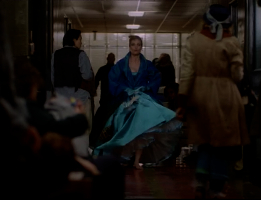
Directed by Geoffrey Sax from a script by Matthew Jacobs, both of transatlantic credentials, allowing reassurance to the executives while providing a continuity of sensibilities, Withnail and I’s Paul McGann was the Doctor, inheriting the role from Sylvester McCoy who returned to provide a regeneration scene, the darkness and mystery of his Seventh Doctor sharply exited when gunned down on the streets of San Francisco.
The only travelling Time Lord ever to have died thusly, carrying the remains of his nemesis the Master from execution by the Daleks to Gallifrey but waylaid en route and crashing down in Chinatown on December 30th 1999, four years ahead of the date on which the story was set no one was to know it would also be a time of confusion, concern and contradictory information as the Millennium Bug counted down, though here the ticking is beryllium decay.
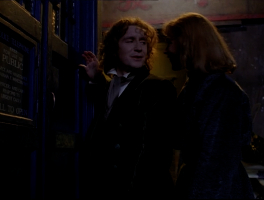
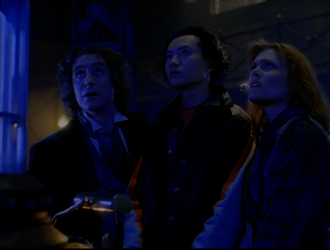
The most accurate clock in the world, required to reset the TARDIS systems, they are the latest victim of the Master in the hijacked body of Bruce, The Ambulance’s Eric Roberts playing three roles in one, concerned medical attendant, sinister venomous menace and then the mad vengeful Time Lord who struts about the dramatic cloister room in the robes of high office, his serpent form twisting the symbolism of the caduceus, using and discarding Chang Lee (Yee Jee Tso) and Doctor Grace Holloway (Daphne Ashbrook), acting with best inventions throughout but faced with the inconceivable at every turn.
Broadcast before the Internet became an accessible repository of obscure information with instant answers for every question, to the most crucial audience demographic Doctor Who was an oddity, occasionally heavy-handed and with echoes of The X-Files, also shot in Vancouver, particularly in the music accompanying the chase sequence, energetic but wilfully strange and counter-intuitive, suitably anachronistic in his purloined Wild Bill Hickok costume but uncharacteristically doubling as a romantic lead, handsome, dashing and kissing his cardiologist, causing consternation among those who saw Time Lords as above entanglements other than quantum.
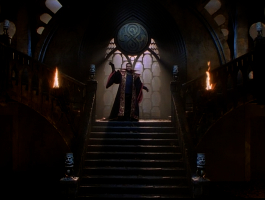
Where the changes to the enduring yet always evolving format do excel, showcased by the restoration work, the picture sharper and brighter than on previous broadcasts and releases, is in the magnificent TARDIS interior, finally given the dimensions it deserved, steampunk long before that term became fashionable and perhaps informed by the Doctor revisiting his friend Herbert George’s novel The Time Machine but also looking to a then-unformed future, in the strong immediate bond with prospective companion “Amazing” Grace, in the sheer scale and sense of adventure of the production and in a Doctor who was less guarded.
A new man joyful in expressions of emotion rather than a slightly removed observer or, as was his immediate predecessor, a manipulator, the Eighth Doctor was a missed opportunity who fortunately found his place in other media, the new edition of Doctor Who – The Movie giving him the platform he always deserved, with new and archive supporting material including commentaries, interviews, documentaries, a tour of the TARDIS set and a wonderful chat between Sylvester McCoy and Janet Fielding covering their careers and myriad connections in the industry, Paul McGann the direct connection linking them.
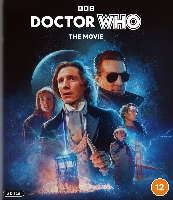
Doctor Who – The Movie is available on 4K Ultra HD, Blu-ray and DVD from BBC now